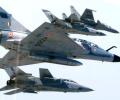
'With the Balakot strike, India has now established a precedent for response to any new terrorist attack engineered by Pakistan.' 'This will stay irrespective of who wins the coming elections,' says Colonel Anil A Athale (retd).

China's and India's nuclear doctrines mandate 'No First Use' of nuclear weapons, so use against each other seems unlikely.

Surface-to-surface Agni V missile is launched from the Wheeler Island off Odisha coast on Thursday

Avinash Chander's contract was terminated 15 months before his term was over

Confronted by outrage in Greenland, the US has scaled down a proposed visit to the island.
Rediff.com takes a look at how India bolstered its defence preparedness this year.

North Korea had recently called on its citizens to be ready for a nation-wide struggle against 'war thirsty' Trump.
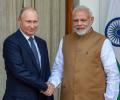
India announced its intention to acquire S-400 'Triumf' surface-to-air missile systems in 2015. The contract worth $5.43 billion was signed during the visit of President Putin to India last year.
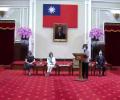
China on Friday announced sanctions on US House Speaker Nancy Pelosi and her immediate family members for her visit to Taiwan this week, disregarding the strident warnings from Beijing, asserting that it violated China's sovereignty and the "One China policy".

Like the Shourya and Prahar missiles, the Pralay is powered by conventional solid fuel, and its payload is designed to carry only a conventional warhead.
After three successful ballistic missile tests during the last fortnight, the Defence Research and Development Organisation is finalising preparations for the big one.

Defence Research Development and Organisation Director General Avinash Chander on Saturday said that India's missile programme is purely aimed at peace in the country.
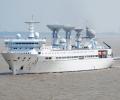
Sri Lanka has decided to impose a one-year moratorium in allowing foreign vessels to conduct research in the island nation's territorial waters, Foreign Minister Ali Sabry has said, amidst frequent docking requests from Chinese surveillance ships.
Any failure in the launch of the missile, which has a range of 3,000 km, 'would be a great setback to defence scientists', he added.
The Indian army will have to wait four to five years to acquire Inter-Continental Ballistic Missile Agni-5, which was successfully tested on 19 April by the Defence Research and Development Organisation. Sheela Bhatt reports

During the phone call, Trump underscored the determination of the US to defend itself and its allies from the growing threat posed by the North Korean regime, the White House said.
The first-ever night trial of India's nuclear capable Agni-II Intermediate Range Ballistic Missile has failed to meet all the mission parameters, defence sources said on Tuesday.
The armed forces have been pushing for adequate allocation of funds so that they are well prepared to deal with the possibility of a "two-front" war on both northern and western borders.

DRDO chief G Satheesh Reddy Reddy is the first Indian to be appointed Fellow of the Royal Institute of Navigation and of the Royal Aeronautical Society.
India successfully testfired its indigenously developed, nuclear-capable, ballistic missile Prithvi-II from the Integrated Test Range at Chandipur, about 15 km from Balasore off the Orissa coast, on Friday.
The first test firing of the surface-to-surface missile with a range of over 3,000 km ended in failure on July 9 when, after a smooth take off, it plunged into the sea far short of its intended target.

Rajaram Panda explains why the US president needs to restrain himself and build a relationship with China to put any credible pressure on North Korea.

'With two nuclear neighbours, how likely is it for our armed forces to battle in a contaminated environment that could include nuclear, biological or chemical attacks by the adversary?' 'Are we prepared for the threat?' Brigadier S K Chatterji (retd) explains the meaning and significance of Operation Vijay Prahar.

United States Defence Secretary Chuck Hagel on Wednesday discussed with his new Chinese counterpart General Chang Wanquan the emerging threat from North Korea, which has threatened to hit American bases in Hawaii and Guam.

China was the first country to export such sensitive equipment to Pakistan

Russian President Vladimir Putin on Wednesday monitored drills of the country's strategic nuclear forces involving multiple practice launches of ballistic and cruise missiles, the Kremlin said.
Pyongyang wants the world to recognise its nuclear capability, says Srikanth Kondapalli.

Chinese President Xi Jinping has bestowed special honours on a PLA battalion posted in Tibet close to Arunachal Pradesh for its "outstanding performance in safeguarding borders".
This is the first time Agni-III has been test-fired.
A Chinese Navy warship capable of surveillance has docked at the Colombo port, nearly a year after another spy vessel berthed at a strategic port in the country and raised concerns in India.
India is on a shopping spree at the Farnborough Air Show in England

'In India, China's capacities to conduct new types of warfare is critically underestimated,' says Claude Arpi.

The US also blasted China and Russia for not joining hands with the international community in their efforts to combat the North Korean threat.

Engagement with neighbours is a strategic imperative, and not an option, asserts Rup Narayan Das.
India's Defence R&D Organisation has announced that it would conduct a full-scale test of a two-stage anti-ballistic missile system by June 2008.
The Information Ministry also said Paksitan has a right to launch a pre-emptive strike if India thinks the same way.
The Generation-next hypersonic inter-continental ballistic missile is capable of dodging any future missile shield.
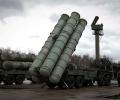
With cruise missile and air strikes being India's most likely response to a hypothetical Pakistani terrorist outrage in the future, retaliation from the Pakistan air force is inevitable. That is where the S-400 will come into play, says Ajai Shukla.

Experts said India has possessed the anti-missile technology for several years but needed the political go-ahead to actually test it in live conditions.
The nuclear-tipped Agni-III has all cities in both Pakistan and China, including Beijing, within its striking range and will be India's second strike deterrent.
